How to Build a 90-Day TEF Canada Study Plan for CLB 9

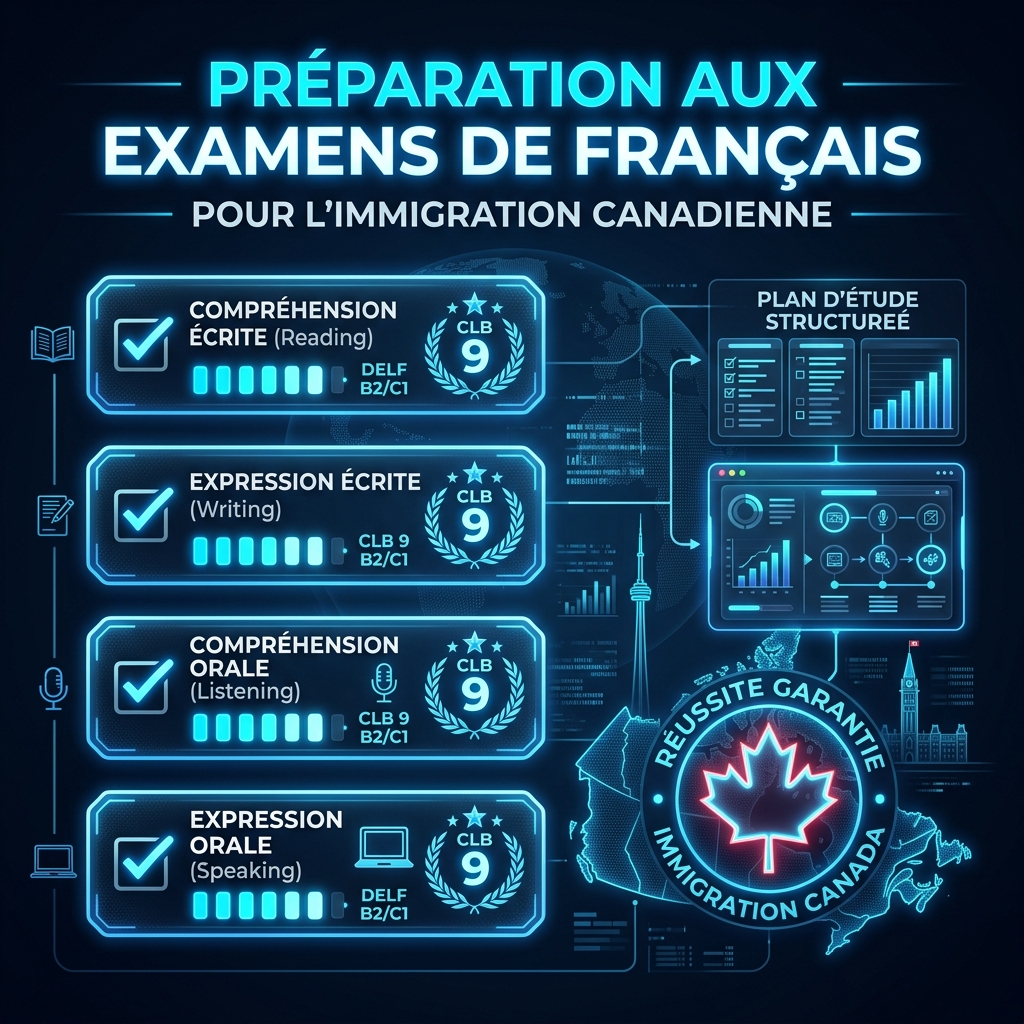
Most Express Entry candidates start TEF Canada prep with a vague goal like "get better at French" instead of a plan mapped to the exact score they need. This guide gives you a structured 90-day plan built around the specific CLB 9 thresholds for each of the four skills, so every week of study is aimed at a concrete target instead of general fluency.
Key Takeaways
- A 90-day plan works best split into three 30-day phases: foundation and diagnostic, skill-specific drilling, and full timed simulation.
- Map your weekly study time to your weakest section first. Hitting CLB 9 on three sections and CLB 8 on one still drops your combined CRS points.
- Avoid the common mistake of relying on casual conversation practice; the exam tests formal, structured French across all four skills, as covered in three biggest French prep mistakes.
- Full timed mock exams should start no later than week 9, not week 12, so you have time to react to what a real mock reveals.
Phase 1 (Days 1-30): Diagnostic and Foundation
The first 30 days are not about intensive drilling. They're about finding out exactly where you stand against the four CLB 9 thresholds detailed in our TEF Canada score breakdown: 248/300 Reading, 298/360 Listening, 371/450 Writing, 371/450 Speaking. TEF Canada is administered by France Éducation international, the official body responsible for the exam's structure and scoring.
Week 1-2: Baseline diagnostic
- Take one full, timed practice exam across all four sections before doing any targeted studying.
- Score each section honestly against the CLB 9 thresholds, not a general pass/fail feeling.
- Identify your weakest 1-2 sections. This determines where Phase 2 time gets weighted.
Week 3-4: Foundation building
- Reading and Listening: start daily exposure to formal-register French. Read Le Monde or Le Devoir editorials, not news summaries. Listen to French radio segments at natural speed, not slowed-down learner audio.
- Writing and Speaking: learn the fixed formats each section actually grades. A fait divers is a short, factual news brief with a fixed journalistic structure, one of two required formats in TEF's written section, alongside an argumentative essay. The oral section has a formal information-gathering task (Section A) and an informal persuasion task (Section B). Each gives you roughly 1 minute of preparation time (TEF Canada Expression Orale format, Rossi ELTS), as detailed in our Expression Orale guide.
Most candidates skip the diagnostic step and jump straight to drilling their perceived weak area. That's a mistake: perceived weakness and actual scored weakness often don't match, especially in Writing and Speaking, where self-assessment is unreliable without a rubric. A real diagnostic against the CLB 9 thresholds catches this before you waste three weeks on the wrong section.
Phase 2 (Days 31-60): Section-Specific Drilling
This is the highest-leverage phase. Time allocation should follow your Phase 1 diagnostic results, not an even split across all four skills.
| Section | If this is your weakest | Weekly focus | |---------|--------------------------|---------------| | Reading | Below 248/300 | Timed editorial analysis, 3-4 texts per week, argument-structure mapping | | Listening | Below 298/360 | Non-stop timed audio drills; practice reading question prompts before audio starts | | Writing | Below 371/450 | One fait divers + one argumentative essay per week, reviewed against a grading rubric | | Speaking | Below 371/450 | Section A and Section B drills, 2x per week each, recorded and reviewed |
Weeks 5-6: Drill your single weakest section intensively, 60% of study time. Maintain light practice on the other three (20-25% combined) so they don't decay.
Weeks 7-8: Shift to your second-weakest section as primary focus. By the end of week 8, you should have done at least 4 full practice attempts in each of your two weakest sections.
Phase 3 (Days 61-90): Full Simulation and Refinement
The last 30 days shift from isolated section drilling to full, timed, exam-condition simulation. This is where candidates discover problems that section-by-section practice never reveals, like fatigue affecting Speaking performance after 2+ hours of prior sections.
Weeks 9-10: Take one full timed mock exam per week. Starting mocks by week 9, not week 12, gives you two full review cycles to react to what the mock actually reveals before test day.
Weeks 11-12: Focus remaining time on whichever section scored lowest in your week 9-10 mocks. Take a final full mock in week 12, at least 3-4 days before your actual test date, to avoid cramming fatigue on exam day.
Frequently Asked Questions
What if I only have 90 days but I'm starting from a low baseline?
If your Phase 1 diagnostic shows you're far from CLB 9 across multiple sections, 90 days may be tight. Consider whether a longer runway or a lower interim CLB target for your first attempt (with a planned retake) is more realistic than compressing all four skills into 90 days.
Should I study all four sections equally every week?
No. Even during Phase 2, keep light maintenance practice on your stronger sections while concentrating the majority of your time on your weakest one. A CLB 9 in three sections and a CLB 7 in the fourth still lowers your combined benchmark, as explained in our score breakdown post.
How many full mock exams should I take before test day?
At minimum, one in week 1 (diagnostic), one at week 9, one at week 10, and a final one in week 12, leaving a few days of buffer before the actual exam. More mocks are useful if your schedule allows, but each one should be reviewed in detail, not just taken and forgotten.
This plan reflects publicly documented TEF Canada scoring thresholds and structure, cross-referenced across our own published score breakdown and independent exam-format guides. Every Francais Pro blog post is published with BlogPosting schema.org structured data. For our editorial approach, see our About page.
Ready to start your diagnostic? Check your readiness with our timed exam simulations, built to replicate the actual TEF Canada timing and scoring rules.